
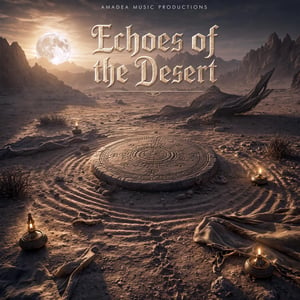
Students Noah Charles, Gus James and Grace Wright have written seven of the ten tracks on Echoes of the Desert, a cinematic production music album out now on Amadea Music Productions.
The album was developed by Music & Sound for Film & Game Course Leader Dr. Hans Hess with Gus, Noah and Grace, all third year students on our BA (Hons) Music and Sound for Film & Game degree at our Bristol campus. The album is aimed at licensing across film, television, documentaries and advertising and gives all three composers a published, commercially released credit while they are still studying.
The project started from an existing relationship between Hans and the label. "I had an existing relationship with Amadea, having previously written a full-length album for the label," he said. "I then developed a brief for another album, which Amadea approved, and invited students to collaborate with me. It was an opportunity to involve them in a professional commission and guide them through the process of creating music for commercial release."
Working to a brief
The brief, originally titled Empires of Civilisation, asked for cinematic music suited to historical documentaries, combining orchestral writing with instruments associated with the cultures being explored. It set out guidance on atmosphere, instrumentation, musical structure and how the tracks could support storytelling.
"Within that framework, students had room to develop their own themes, textures and arrangements," said Hans. "The creative challenge was to bring their individual musical ideas to a clearly defined professional brief."
Writing for licensing asks different questions of a composer than writing for release. "They had to think about how an editor might use their music to support a visual narrative," he said. "For this project, that meant working within a clear three-act structure: establishing a main theme or atmosphere, developing it, and bringing it to a satisfying conclusion. A strong, recognisable musical hook was central to this. They also needed to consider dynamic changes, pauses and clear sections that would give editors flexibility when fitting the music to picture."
.png?width=505&height=758&name=BRS%2015-09%20-%2089%20(1).png)
The student side
Noah Charles composed Caravan of the Sands, Routes of Silk and Steel and Courts of Jade.
"A particular aspect I focused on was to abide by a three-act structure with clear breaks," he said.
"Whilst this technique is used to give video editors more flexibility, it means you're having to develop the tracks so that each musical act can hold up as its own entity, similarly to how a symphony has pauses in between each movement. I would say this is what I found most challenging about this project, especially doing it within three minutes, although it's a vital skill to learn."
The detail work continued right to the end. "Around about the end of the project, I realised some of the solo instruments required some attention to their dynamic shaping, so this involved some last-minute tweaks to the velocities of each note to give the effect of a natural performance," he said. "Overall, I found that this was a great first venture into library music and would highly recommend giving it a go for a different kind of challenge."
Grace Wright worked on The Great Wall Awakens. "I brought my orchestration ability and passion for cinematic harmonies to this project," she said. The hardest part was "capturing a sense of authentic, traditional Chinese culture through instruments whilst blending and balancing this with a standard orchestra to create a unified sound."
Grace approached it as a commercial job from day one.. "I always thought of it as commercial work rather than coursework, as I felt an extra layer of pressure to get things perfect," she said.
Gus James wrote Deserts of Persepolis, Sultans and Spires and Dragon Throne. "I wanted each track to have a clear narrative, so that they would be able to fit with visual media easily," he said.
The discipline of the format was the part that took work. "The hardest part of the project was sticking to the production music format and keeping everything simple through each track," he said. "I never usually like to stay on one idea for too long, so it took some effort to sit with only one or two core elements per track."
He already writes music for media, but the album marked a first. "This project ended up being my first officially released music on streaming services, which was an amazing feeling," he said.
What a published credit opens up
A licensable credit carries weight once students start approaching labels and collaborators of their own. “It gives them a tangible professional credit and demonstrates that they can follow a brief, respond to feedback and deliver music to a commercial standard,” said Hans. “There is also the potential to earn royalties when their music is placed and broadcast, although publication alone does not guarantee income. Production music can provide a practical route into the industry, allowing graduates to build their catalogue, develop professional skills and pursue earning opportunities alongside their other career ambitions.”
Listen to Echoes of the Desert
Interested in composing music for film?
Explore our BA (Hons) Music & Sound for Film & Game, then come and see the studios at an open day.